Any item which contains spice should be thought about much more dangerous to take in than delta-8 and trusted dealers will frequently decline to offer spice products over security issues. Delta-8 THC is a safe, brand-new kind of recreational THC that has actually established quick popularity and is rapidly appearing around the United States.
The cannabis market in the United States remains in a state of rapid modification with new innovative products being launched in fast succession. It is very important for customers to comprehend the items they are purchasing, particularly when those items have a psychoactive impact and this guide ought to have provided you a better understanding of this complex industry.
Delta-8-tetrahyrdocannabinol is a hemp-derived cousin of cannabis that is often consumed in edibles such as gummies. Release Date: January 12, 2022 Share This Print "While delta-8-THC appears to have some actually huge, positive qualities, we require to know more, and we should be cautious with any product that's striking the market uncontrolled and untested.
It's all over from gas stations to grocery stores and trendy boutique shops, all promoting the availability of "delta-8-THC." It's a hemp-derived cousin of delta-9-tetrahydrocannabinol (THC) more commonly called cannabis the active ingredient in the cannabis plant that provides the "high" people feel after using it. And it's the topic of a great deal of debate and discussion in state legislatures, amongst public health practitioners and specifically consumers, a lot of whom have turned to delta-8-THC to treat a broad series of health and medical conditions.
Biggest delta-8-THC study to date It's the largest research study to date on users' experiences with delta-8. The findings have actually been published over 2 documents, one that appears in Cannabis and Cannabinoid Research Study, the top peer-reviewed journal in the field, and another, just-published paper in the open gain access to Journal of Marijuana Research Study."Because this is one of the first studies of its kind on delta-8-THC and so many states have altered their legislation, we wanted to really explore what people felt as they were utilizing it compared to delta-9-THC.
Kruger co-authored both papers with Daniel J. Kruger, Ph, D, a research private investigator in the Population Researches Center at the University of Michigan who likewise has a professors association in UB's School of Public Health and Health Professions. Research on delta-8-THC is limited, and the Krugers' work comes as more states are legalizing marijuana for recreational and medicinal usage, while forbiding delta-8-THC.
On average, individuals' experiences of fear and anxiety while using delta-8-THC were in between "not at all" and "a little."Participants likewise revealed little understanding on reliable dosages of delta-8 and said the majority of what they did understand about it came from the web or their own experiences. Delta-8 product users were more than passionate to share their experiences, said Justin Schultz, Bison Botanics' creator and president."A lot of customers that use delta-8 are so happy with its healing results, and they're worried it might be taken away.
"We're confident the state is taking this details seriously and is prepared to adapt or build its legislation based upon public feedback. They're not ignoring our industry."The researchers say it's critical to study delta-8-THC and other cannabinoids pertaining to market to notify policies, policies and practices that minimize the expenses, risks and harms while maximizing delta-8-THC's prospective advantages."While delta-8-THC appears to have some truly big, positive qualities, we require to understand more, and we need to be cautious with any product that's hitting the marketplace uncontrolled and untested," Jessica Kruger said.
The majority of people know that tetrahydrocannabinol (THC) is the active ingredient in cannabis that provides it psychoactive residential or commercial properties, but not everyone recognizes that THC has several different types. Delta 9 THC is the most common form of THC discovered in the cannabis plant, so it has the honor of being called simply "THC." This short article is a comprehensive guide to delta 9 THC, covering everything from its chemical structure and potential benefits to side effects and legality.
This strategy integrates marijuana plant matter with CO2 that's been placed under very high pressure and low temperature. This triggers CO2 to become a halfway state where it's both a liquid and a gas at the very same time. This stage is referred to as "supercritical." Supercritical CO2 has the very same properties as chemical solvents however is much more secure.
It's considered a Schedule I drug in the United States which is the same classification as cocaine, heroin, and LSD. Cannabis products are only legal in states with overriding marijuana laws or in products made from non-psychoactive hemp. Hemp is specified as any marijuana plant that produces less than 0. 3% THC by dried weight.
These technically have low concentrations of THC despite containing enough to make a psychedelic dosage. It's unlikely these items will remain legal for much longer. THC is mainly controlled on the state level. Despite being prohibited on the federal level, the majority of states allow either the medical use or recreational use of THC products.
This is not the like a hallucination; rather, it is a more extreme experience of the very same sensory inputs. Laughter and giddiness are also normal when taking THC, and some individuals will experience an altered perception of the passage of time. It prevails for hours to seem like minutes when taking THC.
What Are the Side Effects of Delta 9 THC? Delta 9 THC has reasonably couple of side effects, and the majority of people who take it don't experience any unexpected negative results. Nevertheless, some people have actually reported feeling nervous, paranoid, and panicky when taking THC. This is more common among individuals who take big amounts of THC (more info on dose size later).
Novices need to take small dosages around 5 mg, while skilled THC users might take as much as 50 mg in a single dosage. Metabolic factors also influence dose size and can trigger two people to respond differently to the exact same dose. This is why novices must begin by taking percentages of THC and increasing the dosage size slowly until they find the best quantity.
Put another method: there is no recognized lethal dose of delta 9 THC. Many individuals stay with the 5 mg to 50 mg range; taking more can cause unwanted side impacts like fear and stress and anxiety. Some individuals may experience hallucinations, deceptions, and psychosis in severe cases, although these are rare.
Smoking Delta 9 THC The most well-known approach is smoking it in a bong, pipe, or joint. Cigarette smoking delta 9 THC items in this method featured possible side impacts from breathing in smoke, however that's beyond the scope of this short article. You can smoke THC-rich cannabis flowers, THC focuses, rosins, live resin extracts, shatters, waxes, pastes, and more.
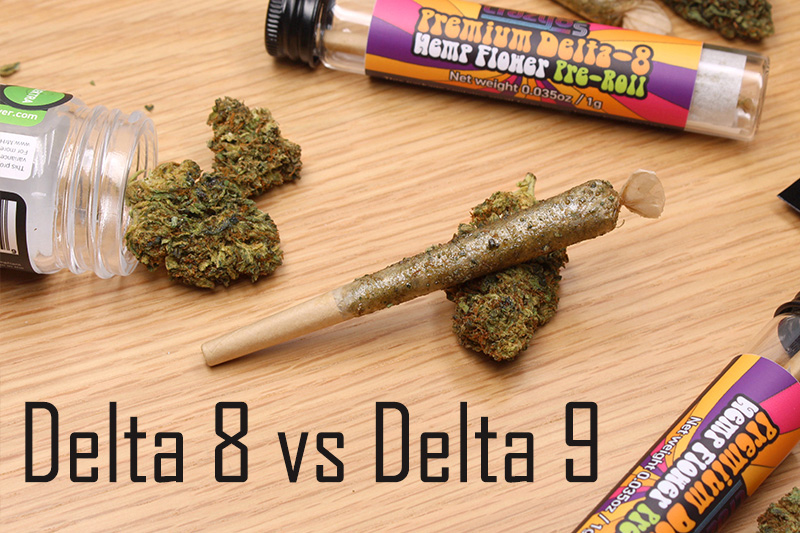
Here's how it compares to other typical cannabinoids. Delta 9 THC vs. Delta 8 THC Delta 8 and delta 9 THC have identical chemical solutions and only vary by the location of a carbon double-bond. This little chemical difference manifests as a large difference in effectiveness, making delta 8 THC about 5060% weaker than delta 9 THC.
Delta 9 THC vs. Delta 10 THC Delta 10 THC is an isomer of THC that only occurs naturally in minuscule amounts. It's unstudied generally due to its tiny concentrations, however it looks like delta 10 THC is substantially less psychoactive than delta 9 THC. When comparing delta 10 THC to delta 9 THC, the primary difference is that delta 10 has to do with 50% as strong in regards to the psychedelic results but has a higher stimulating or promoting action.
Delta 9 THC vs. THC-O THC-O or THC-O acetate is a hemp-derived compound that (might) have a more flexible legal status than delta 9 THC it's unclear at the minute. Some professionals suggest THC-O is federally legal in the United States, while others believe it's illegal under the Federal Analog Act.
Delta 9 THC vs. CBD CBD has actually emerged in recent years as a popular methods of gleaning a few of the benefits of cannabinoids without the psychedelic baggage THC carries. People who wish to use cannabis however don't wish to feel high gravitate to CBD. More particularly, CBD doesn't connect with CB1 receptors the method THC does.
What is Synthetic THC? Is it Safe? Artificial cannabinoids, in general, are substances created to engage with the body's endocannabinoid system. These synthetic molecules have a large range of effects, and some have serious negative effects that can cause extreme injury or death. Particles that possess a similar structure to the THC particle are called, while molecules with various structures are called.